Monday, November 7, 2011

A week in Vietnam


Have just returned to Hong Kong this past weekend after spending last week traveling throughout Vietnam.  We were on the move to see as much as possible in one week - but could have easily spent another week or two in the country just to see it all! Overall the cities were crowded, noisy and polluted. It was a miracle crossing the streets given the hundreds of motorcycles going by at any one minute (the trick is to move slowly through the motorcycles rather than try to run across the street during an opening in traffic – which won’t exist). My favorite parts of Vietnam were the more rural parts – the Mekong Delta in the south, Sapa in the north in the mountains and Halong Bay in the north along the coast.

In my longest posting yet, here goes an attempt to describe a very busy week full of Vietnam adventures:

Our boat for 2 days / 1 night
We flew from Hong Kong directly to Saigon (officially Ho Chi Minh City, but everyone still calls it Saigon), where we spent one night, then left first thing in the morning to head south to the Mekong River Delta. We spent the night on a riverboat called Dragon Eyes which took us from Cai Be to Can Tho.  The delta was incredibly busy with boats – people living on boats, transporting goods, hauling building materials, fishing, tourists like us, etc.  We also passed various towns along the edge of the water, which primarily consisted of run down buildings.  In Can Tho we experienced a water market, where everyone converges on their boats to buy/sell various goods and food.
Local fisherman
Morning at a brick factory
Market along the delta
Most boats had eyes
Evening on the delta

Market in Can Tho

We then returned to Saigon. We walked around the streets, visited a market, a cathedral and the Reunification Palace – where the North Vietnam tanks rolled in on April 30, 1975 and the President of South Vietnam surrendered.  To get our minds off of the atrocious war, we finished the day with a drink on the Sheraton rooftop (a must according to Lonely Planet).

Coffee Bean - from LA to Saigon!
The usual

Reunification Palace - former South Vietnam capital

Reunification Palace frozen in time at April 30, 1975
The North Vietnam tanks rolling in on April 30, 1975
South Vietnam's war room in the Reunification Palace

Saigon marketplace
Notre Dame Cathedral (note the bird on the Virgin Mary's head)

After a day in Saigon, we flew to Hue – the old imperial capital.  In Hue, we visited the Imperial Palace, an old pagoda and two tombs.  Hue is known for its crab/rice paper rolls, which we thoroughly enjoyed. 

Imperial Palace

Imperial Palace

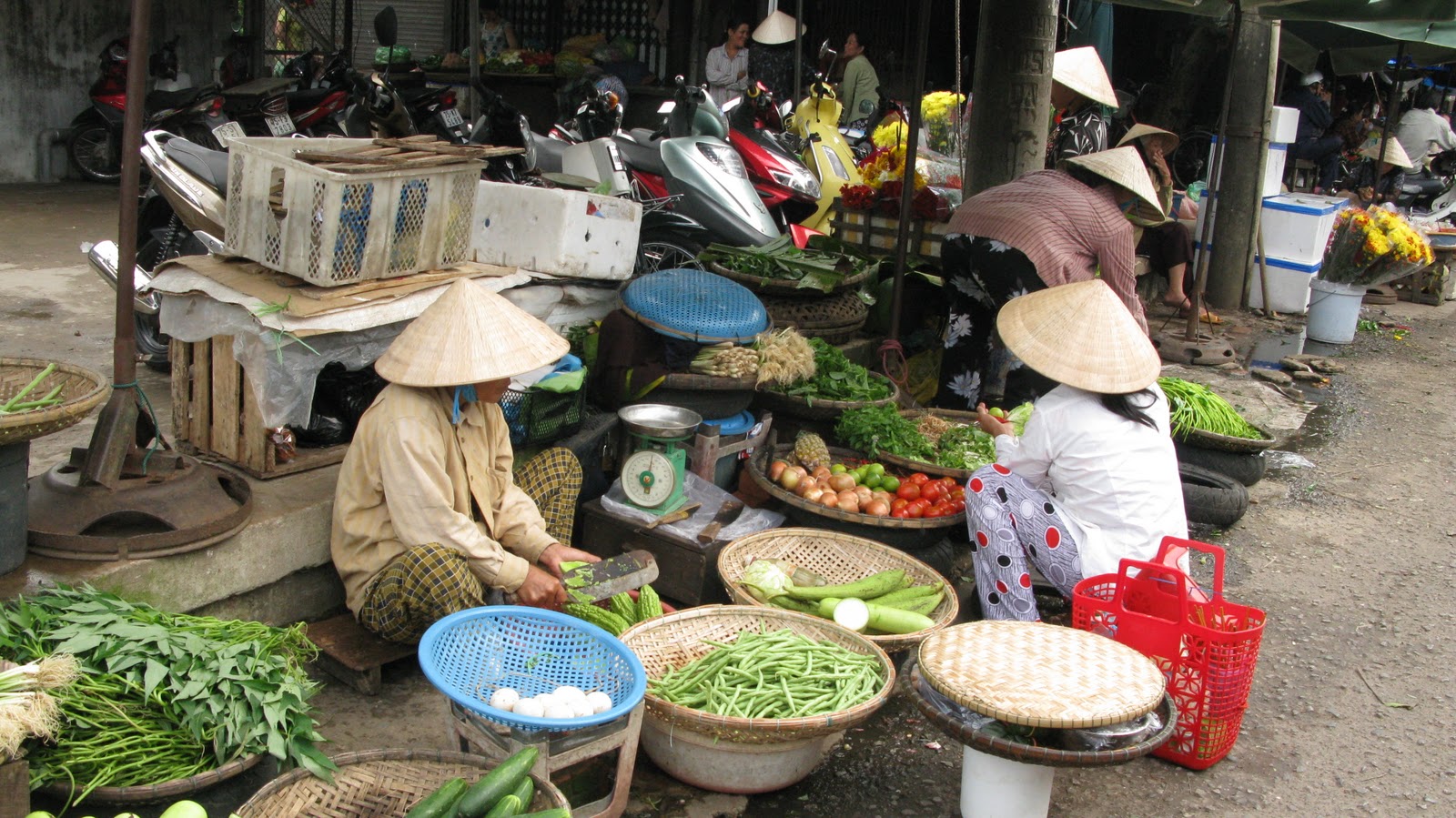
Street market

Hue crab specialty restaurant

Pagoda

Emperor's tomb. Who doesn't belong?

Vietnam's last emperor's tomb

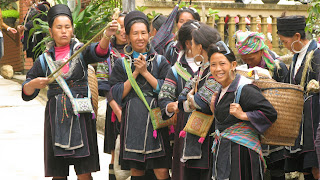
After Hue, we flew to Hanoi, where we boarded an overnight train to take us up to the mountain area of Sapa.  Sapa is home to a number of tribes. We spent two days, one night in Sapa, and hiked throughout several small villages, visiting the Black H’mong and Zhao tribes. We constantly had local women surrounding us, trying to win a tip or sell a trinket.  The local people in this region are very poor, and survive on tourism and rice crops – which look beautiful tiered amongst the hills.  The weather was significantly cooler up in the mountains of Sapa.

In the rice fields

Overlooking the town

Fake North Face on every corner

Black H'mong

Black H'mong women being shooed away from out-front our hotel by Communist govt official

Hiking with the locals

The overnight train

We then took the overnight train back to Hanoi, where we had a transfer scheduled to take us to Halong Bay – an area in the northeast of Vietnam which is up for becoming one of the new Seven Natural Wonders of the World – which I fully support after having seen it! We spent the two days and one night on a beautiful traditional junk boat.  We sailed throughout many of Halong Bay’s seemingly endless array of small islands – over 2,000 in total.  During the late afternoon, we explored a cave in one of the islands, full of stalagmites and stalactites.  We also kayaked around one of the islands during sunset – which turned out to be one of my favorite parts of the trip overall.  

Halong Bay

The islands of Halong Bay

Kayaks on a Halong Bay island

Evening in Halong Bay

Kayaking at Sunset
Halong Bay
Fishing village in Halong Bay

Fishing village again


The next day on the boat we visited a remote and extremely poor village amongst the islands, with a population of 256. The government facilitates for the children to attend school, but most of these students return to their village as soon as possible rather than use education as a tool to escape.  They earn a living by fishing, harvesting pearls and paddling tourists around for tips.

On a small docked boat in the village
After Halong Bay, we went back to Hanoi – a trip which was supposed to take 3 hours but ended up taking 6 hours because of a traffic accident which gridlocked the road for miles - and then flew back to my temporary home in Hong Kong!

Street scene in Hanoi's old quarter
Another street scene in Hanoi's old quarter

Thoughts on Vietnam based on observations and conversations with local tourguides:
-       Still a very poor country, but growing quite quickly
-       Out of every Vietnamese person that I spoke with, no one liked the Communist government. At the same time, no one paid much attention to politics – instead they focused on their families
-       Rice, rice and more rice! Every meal consisted of some form of rice – whether rice noodles in pho soup, rice paper spring rolls or just plain rice. From the north to the south, the country is united by rice
-       We mainly saw women doing most of the work – the women rowed the men around in boats, the women worked the rice fields, the women cooked, the women cleaned. Not sure where all of the men were
-       Motorcycle heaven – it’s common to see families of four piled on to one bike. The children generally don’t wear helmets. Lots of surgical masks work to keep out the pollution and dust when riding. People also cart around live animals strapped to their vehicles – pigs, ducks, geese, chickens
-       They eat dog, cat and snake
-       Usually the nice buildings were government buildings (no surprise in a Communist country). In Sapa, the government officials had very nice cars which they drove amongst dirt roads with people living alongside wandering livestock in houses with dirt floors
-       We visited a school in Sapa which consisted of two classrooms with about 20 children each – all clean and well dressed. The teachers were hanging out together in another separate room and didn’t seem to be in any rush to get back to their classrooms to teach. Surrounding the school were tons of other indigent children who didn’t have the luxury of attending school and instead worked with their families. The whole government propaganda idea of putting the school on the tourist route didn’t quite work as they had imagined…

Now back to classes in Hong Kong… but my next trip is right around the corner – a quick 2 days in South Korea later this week!
 

Friday, October 21, 2011

Journal entry


This week is finals week (our term is split into two halves), so it has been relatively quiet. I have two presentations, two papers and one exam, all of which are quite manageable and not overly stressful. I do most of my work in coffee shops, but did venture to the school library for a full day earlier this week to write a paper.  Made me feel a bit like an undergrad again – especially since the campus is somewhat removed from the hustle and bustle of Hong Kong and full of young college students! Also spent some time meeting with one of my teams to work on a presentation we will be giving tomorrow. 

Study group
As a little break, a group of us spent a few hours mid-week at the beach in Repulse Bay, which is only about a 15-minute bus ride from Central Hong Kong.  And no, Repulse Bay is not repulsive!  Apparently Repulse Bay received its name from a battle in 1841 when the British repulsed local pirates.  It is a very nice beach, next to Discovery Bay and not far from Stanley.  The beach has an extensive protected swimming area surrounded by shark nets and several floating rafts.  

Repulse Bay

We had a great time relaxing at the beach until the busloads of Mainland Chinese tourists started arriving… they were more interested in us than in the beach!  It was fun being in pictures with the first busload, but there is only so much smiling for a camera one can do.  When we hit our limit, it was time to go. 

Photo of photo
This week I also had a funny déjà vu moment.  Was jogging along Victoria Harbor in the Sun Yat Sen Park, but felt as if I was jogging my old familiar route along the East River in NYC (which is not quite as nice as the run along the Hudson). The placement of the path right on the water, the benches alongside, the boats in the Harbor, some sports fields nearby, the sound of cars, an industrial building that reminded me of NYC's ConEd building, etc. Many similarities to transport me back to my old stomping grounds.

Now time to study for an exam tomorrow!

Sunday, October 16, 2011

Jim O’Neill (Mr BRIC) comes to HKUST


Jim O'Neill takes the stage
This past Friday, economist Jim O’Neill gave a talk at HKUST.  O’Neill is most famous for coining the term BRIC countries (referring to Brazil, Russia, India and China) in 2001; he now serves as the current Chairman of Goldman Sachs Asset Management.  His talk took place in a large auditorium on campus, which was packed with students, local professionals, and plenty of media (who played the paparazzi role very well throughout most of the speech - flashes galore!)

He discussed the difference between emerging markets and growth markets, claiming that the BRIC countries can no longer be called emerging markets, but should be referred to as growth markets.  He identified the N-11 countries (next 11) as Mexico, Korea, Turkey, Indonesia, Nigeria, Pakistan, Egypt, Poland, Vietnam, the Philippines and Iran.  Growth markets would include the BRIC countries and Mexico, Korea, Turkey, Indonesia.  He would classify the remaining 7 countries listed above as emerging markets.  

Giving his speech (notice the media!)
O’Neill was especially bullish on China.  He believes that the Chinese will become better innovators, which will make them more competitive on the global stage.  He even claimed that he thought everyone’s concern over Greece to be a bit overdone since this situation pales in comparison to China’s actions.


O’Neill’s main message was nothing earth shattering - that future global growth will be driven by the growth markets, followed by the emerging markets. However he is a gifted speaker and delivered his message eloquently.  What he did not touch upon was the significant level of both bottom up and top down due diligence required to profit from investing in higher risk growth and emerging economies.

Thursday, October 13, 2011

Guangzhou


I spent this past Tuesday with a tour group (primarily my classmates) in Guangzhou, which is about a 2-hour train ride north of Hong Kong.  Guangzhou, formerly known as Canton, played a significant role in China’s history, dating back to China’s BC dynasties. Today Guangzhou is an important port city.  Of course the tour advertising made Guangzhou sound like a wonderful day trip.  In reality, it is a large (population 17 million!), industrial and polluted Tier II city...

Kindergarten students & teacher
We started our tour at a Mainland China kindergarten - why, I don’t know.  It was one of the stranger tour activities I have ever done in my life.  I believe it was a sort of Chinese propaganda, as the tour guide kept talking about the wonderful education the Mainland children get, and how wonderful all of the school facilities are.  In truth, it was a nice kindergarten – but highly unlikely that all kindergartens look like this.  Speaking of propaganda, we also received an earful about why Chinese medicine is so much better than Western medicine.

After hearing the kindergarten children sing and having our pictures taken with them (note that they made us have our photos taken with the kids, which was also a little weird), we continued on to a museum. At the museum we saw some terracotta soldiers from Xian and lots of jade.  We also learned that when you see Chinese lions on both sides of a doorway, the female will have its right foot forward and will be on the right side (when looking out the door). 

Tour guide Ricky with Chinese door lion

Intricate jade boat


We then went to a zoo to see a panda.  Would have been much nicer to see a panda in a more natural environment, but this was the best we could do. 

For the remainder of the day, we walked around a street market, saw the Six Banyon Tree Temple (dating back 1400 years) and the Memorial Hall of Dr. Sun Yat Sen.  
In front of the Dr Sun Yat Sen memorial

1,400 year old pagoda - Six Banyon St Temple

Artist painting with his fingers (at one of the requisite tour store stops)
 A few photos from the streets of Guangzhou:
Nap time
Mahjong
The day was interesting, but I was happy to be back in Hong Kong that night.  After visiting both Shenzhen and Guangzhou within about a week’s time, I have had my fill of China’s Tier II cities!

Saturday, October 8, 2011

Shenzhen (ie, the world's manufacturing hub)


Buildings in Shenzhen
A highlight of this past week was a relatively spur of the moment trip to Shenzhen, one of the largest manufacturing bases in the world, located less than an hour north of Hong Kong in Mainland China. Lisa and I went on Tuesday night with a group of friends - Spanish ex-pats bankers here in Hong Kong - who had Wednesday off because of a national holiday. They've been to Shenzhen numerous times so knew what to do and where to go, thankfully! Otherwise may have been a bit overwhelming. And not much English spoken there.


Never-ending lineup of cabs at Shenzhen train statio

Shenzhen was China's first Special Economic Zone, established in 1979, and thus has attracted significant foreign investment over the years, primarily for manufacturing. The city was established as an SEZ because of its close proximity to Hong Kong, and the two cities today have close business and trade ties.


Upon arriving we went through immigration, showing our Mainland China visas. We then walked over to our hotel and headed out for dinner, followed by a Chinese nightclub. With hardly any Westerners in the club, we were treated like celebrities! The club played a mix of Western music and Asian music. My one complaint was the unescapable smoke - made me realize how nice CA & NY's no smoking inside policy is.


Shenzhen nightclub
The next day we went to a spa for a few hours of major relaxation. I had a great 100-minute massage for US$20. Then... the shopping! Went to a 5 story mall full of little shops, all of them brimming with fakes. Handbags, shoes, jeans, sunglasses, tennis racquets, golf clubs, electronics, cameras, binoculars, etc.... The list goes on and on. The Chinese are known for being good copiers, and I can attest to this firsthand. They literally had catalogs of all the new designer handbags and accessories, then showed us their versions. They are all willing to strike a bargain, of course. Rule of thumb is to pay less than 1/2 of the starting asking price. The going rate for DVDs is US$1.00 each. 

Made it back to Hong Kong Wednesday night, exhausted from 24 hours in Shenzhen. It's not unusual for Hong Kong'ers to head to Shenzhen for a very cheap day of food, spa and shopping. I'll be back!


Monday, October 3, 2011

Weekends in Hong Kong


Shopping, shopping and more shopping. That is what thousands upon thousands of Hong Kong Chinese seem to do every weekend. Good luck walking around any one of the many malls, given the weekend crowds (actually it really is busy every day of the week!). And in each of these malls, it’s amazing how many diamond, jewelry and high-end fashion stores you’ll pass. As for the ex-pats (probably most being British & Australian), they all seem to crowd into the bars and pubs to watch rugby or soccer.
Typical Saturday night in Lan Kwai Fong

 
Saturday nights are crazy in Hong Kong - especially in Lan Kwai Fong (aka LKF), which is where everyone seems to be. This area is packed with restaurants, bars and nightclubs, which stay open until the wee hours of the morning.  My first weekend here in Hong Kong, I thought that there must have been some sort of street party or festival going on that Saturday night, as hundreds of people packed the streets with drinks in hand. But no, I later learned that this is how Lan Kwai Fong is every weekend!
The girls out in LKF


Sundays in Hong Kong are interesting, as this is the day that all of the Filipino and Indonesian housemaids are off. Most of them live in tiny rooms in apartments with the families they serve – one of my professors, for example, has two Filipino helpers who live in bunk beds in a small room in his family’s apartment. Where do these migrant workers go on their day off?  Having nowhere else to go, they spend their day sitting along several major streets and walkways in Hong Kong – which become almost entirely filled with Filippino and Indonesian women. 


They bring their flattened cardboard boxes to sit on and their food and playing cards. Even when it is dreadfully hot outside, or windy and rainy, there they are – group after group after group. Many seem to make the most of their situations by creating their own joy – talking, laughing, singing and sometimes even dancing.


There is another segment of migrant domestic workers – usually women in their 20s and 30s - who head to Wan Chai on Sundays (Wan Chai is a bustling area of the city where all of the seedy nightclubs are located). They go to clubs to party the day away, meeting plenty of old, sketchy British men who go to Wan Chai knowing exactly what they’ll find.  
According to one of my Filipino friends here: “everyone just wants to get out of the Philippines.” I knew the Philippines was poor, but I had never had any idea about just how many Filipinos leave their country in search of a better life.